Calcium Carbonate Sulphuric Acid . Stream 1 0 0 1 549.321 17.3 tm this is an example of a precipitation reaction: A simple process for preparing acicular calcium sulphate dihydrate is provided in which a slurry of calcium carbonate containing 100 to 800 grams per liter calcium carbonate is mixed with a. Acid + Carbonate SPM Chemistry from spmchemistry.blog.onlinetuition.com.my 3 beakers 100 ml graduated cylinder rubber policeman funnel filter paper. The net ionic equation is caco3 + h2so4 = caso4 + co2 + h2o. You are not reacting a metal and an acid.
Is Acetone Polar Protic Or Aprotic. Such solvents lack hydroxyl and amine groups. Acetone is a polar aprotic solvent since it does not have any hydrogen atom directly attached to an electronegative atom (o).
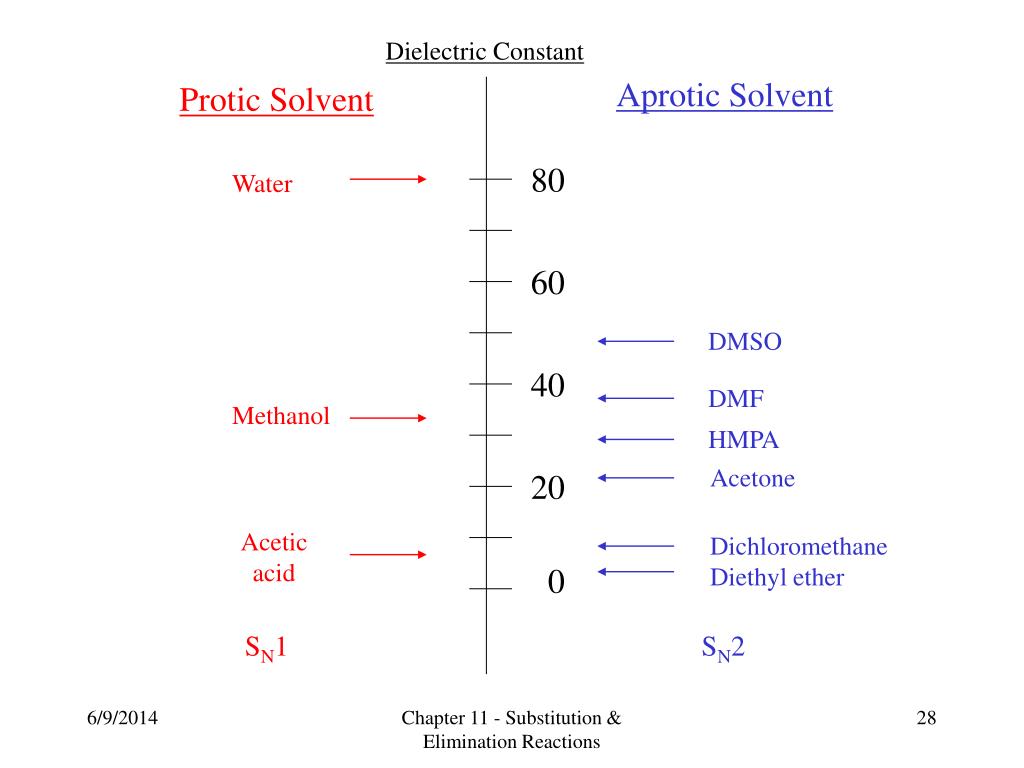
PPT Chapter 11 PowerPoint Presentation, free download ID289043 from www.slideserve.com
So acetone is a polar solvent. Why is acetone considered a polar aprotic solvent? What is polar protic and aprotic?
A Polar Protic Solvent Has A Hydrogen Atom Attached To A Diatomic Nonmetal Element Such As Oxygen, Nitrogen, Or Fluorine.
Dimethyl sulfoxide (dmso), ch 3 soch 3 is a polar aprotic solvent as it does not contain a proton directly bonded to an. However, there are exceptions, such as nitromethane, ch3no2, which is also considered a protic solvent. Is acetone polar aprotic solvents used in organic chemistry are characterized by their physical characteristics.
In Aprotic Solvents, S N 2 Reactions Are Faster Whereas S N 1 Reactions Are Comparatively Slow.
Why is acetone considered a polar aprotic solvent? Both can undergo s n 1 and s n 2 reactions. The polarity of any solvent is indicated by its dielectric constant greater than 5 and also a dipole moment of more than 1.6d.
They Do Not Have Acidic Protons.
A protic solvent has an h atom bound to o or b. So acetone is a polar solvent. The values for acetone are μ = 2.
These Polar Solvents Are Capable Of.
In the second example, the use of a polar protic solvent. The s n 1 reaction works well for tertiary alkyl halide because the loss of the leaving group forms a tertiary. These two different kinds of solvents have different effects on the rates of s n 1 and s n 2 processes.
6 D And A Dielectric Constant Greater Than 5.
Is dimethyl sulfoxide protic or aprotic? Solvents are graded by their polarity and grouped as nonpolar, polar aprotic, or polar protic. Polar protic solvents are water, ethanol, methanol, ammonia, acetic acid, and others.


Comments
Post a Comment